Illustration by OneAppleFall. Not a screenshot of ChatGPT.
Researched October 20, 2026
OpenAI has moved everyone in ChatGPT to its GPT-6 family. The new models replaced GPT-5.6 Sol and GPT-5.6 Luna in ChatGPT, across free and paid plans worldwide. [1] The headline feature is Intelligent UI: instead of only text, answers can now include charts, calculators, comparison tables and other small interactive tools. [3][5]
The naming can be confusing, because GPT-6 is not one model but three, and which one you get depends on your plan. This guide sorts that out.
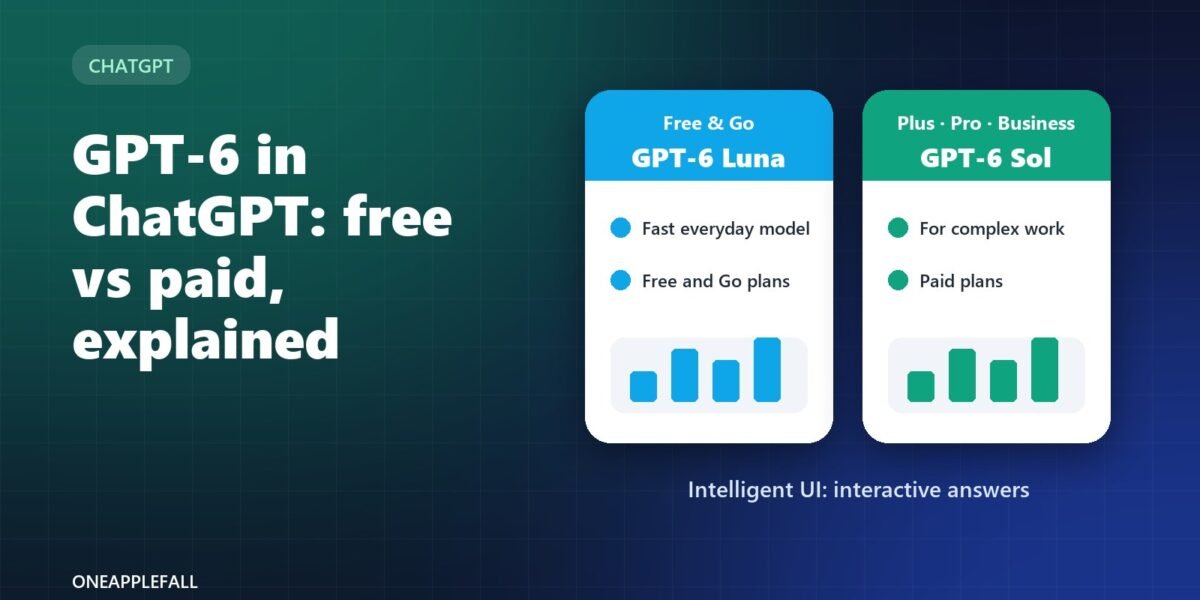
Quick answer: Free and Go users get GPT-6 Luna, the fast everyday model. Plus, Pro, Business and Enterprise users get GPT-6 Sol by default. GPT-6 Astra, OpenAI’s most powerful model, powers Pro’s heaviest reasoning option and is not part of the free plan. [3][4][5] Paid users got GPT-6 on October 7; Free and Go users from October 8. [3][5]
This is a researched explainer based on OpenAI’s published documents and reporting. Plan details change often, so check OpenAI’s pricing page for your region before you pay for anything.
The three GPT-6 models
| Model | What it is for | Who gets it in ChatGPT |
|---|---|---|
| GPT-6 Luna | Fast, routine, high-volume tasks: summaries, extracting information, quick questions [2] | Free and Go (default) [3][4] |
| GPT-6 Sol | More complex work such as coding and longer reasoning [2] | Plus, Pro, Business, Enterprise (default) [3][4] |
| GPT-6 Astra | OpenAI’s most powerful model, for coding, research and computer use [2][5] | Pro’s heaviest reasoning option; first released to selected organisations [4][5] |
Astra arrived first, in September. OpenAI then released new versions of Sol and Luna on September 22 for ChatGPT Work, Codex and the API, before bringing GPT-6 to the regular ChatGPT chat on October 7 and 8. [2][5] OpenAI’s October report notes that people using Sol and Luna in Codex and ChatGPT Work are still on the earlier September versions. [1]
What Intelligent UI does
With GPT-6, ChatGPT can mix text, visuals and interactive elements in one answer. [3] Examples reported so far include:
- calculators and bill splitters;
- comparison tables and side-by-side layouts;
- diagrams and charts;
- forms and tappable buttons;
- small interactive games. [3][5]
ChatGPT decides on its own when to use these elements; there is no switch to turn them on. [3] A few limits to know:
- Interactive answers appear in the Chat tab, not in ChatGPT Work. [5]
- They are not available with the Pro reasoning option, which runs on GPT-6 Astra. [3]
- OpenAI says answers to web-search questions start about 44% sooner than with GPT-5.6 Instant, but it did not publish an accuracy figure for that comparison. [5]
Early reaction has been positive about the interactive answers, though one user noted that generated interfaces can be wrong and harder to check than plain text. [5] If a calculator or table in an answer matters, check the numbers yourself.
What each plan gets
These details come from a plan comparison that cites OpenAI’s pricing page as of October 10, 2026, with US prices. [4] Prices are localised in some countries.
| Plan | US price | Default model | Notable limits |
|---|---|---|---|
| Free | $0 | GPT-6 Luna | Unlimited everyday text chats (with abuse guardrails); separate limits on uploads, images, voice, deep research, memory and Codex |
| Go | $8/month | GPT-6 Luna | Larger context window than Free (54K tokens for instant answers) |
| Plus | About $20/month | GPT-6 Sol | Higher limits and priority access; 256K-token context for reasoning |
| Pro | $100, $200 or $500/month | GPT-6 Sol; Pro reasoning uses Astra | Largest limits; the $500 tier includes a faster “Ultrafast” mode for Astra in Work and Codex |
| Business | From $20 per user/month (annual) | GPT-6 Sol | Standard and Premium seats; minimum two users |
| Enterprise | Custom | GPT-6 Sol, subject to admin settings | Allowances set by contract |
Two changes stand out for paying users. Pro now comes in three tiers, and new Pro 200 subscriptions have a lower allowance than before, according to the same comparison. [4] And for Free users, the long-standing message cap on everyday text chats has been removed, though uploads and other features remain limited. [4]
Is GPT-6 better than GPT-5.6?
OpenAI says so, and has published some evidence, but treat its figures as the company’s own measurements rather than independent tests.
- Fewer mistakes: OpenAI says GPT-6 Sol makes “about half as many mistakes as its predecessor” on an internal test built from real conversations where users flagged errors. [2]
- Factual accuracy: In its October report, OpenAI says both GPT-6 Sol and Luna were significantly more factual than the August GPT-5.6 versions on nearly all its measures, with one exception: claim-level errors on its “factuality-heavy” prompt set. [1]
- Lower API prices: For developers, the GPT-6 Sol and Luna models cost half as much as the GPT-5.6 versions, which OpenAI credits to better caching and inference. [2]
OpenAI also says these hallucination tests are deliberately difficult and “do not reflect production prevalence,” so they show direction rather than how often you will see a mistake. [1]
What OpenAI’s safety report says
OpenAI published a system card update for the October release. In summary: [1]
- Compared with GPT-5.6, GPT-6 resisted jailbreaks better, including attacks spread across several messages, and showed less dishonesty, deception and getting around guardrails.
- Where safety tests got worse, OpenAI says it reviewed the failures by hand and with red-teaming and found the disallowed responses were “generally low severity.”
- On OpenAI’s mental-health benchmark, GPT-6 Luna improved over GPT-5.6 Luna across all levels, and GPT-6 Sol also improved, most clearly in emergency conversations.
- OpenAI treats the October Sol and Luna release as “High” capability in cybersecurity and in biology and chemistry under its Preparedness Framework, and applies the same safeguards it used for GPT-5.6.
None of this means the models are risk-free. If you use ChatGPT for health, legal or money questions, keep checking important answers with a qualified person.
Is GPT-6 available in the UK and Europe?
Yes. OpenAI says GPT-6 is rolling out “across free and paid plans globally.” [1] Some newer features are different: OpenAI’s always-on dots agents, launched on October 6 for some Pro and Business Premium users, are not available to Pro users in the European Economic Area, Switzerland or the UK at launch. [5]
Should you upgrade?
A few practical rules of thumb, based on what each plan includes:
- Stay on Free if you mainly ask everyday questions and write short texts; GPT-6 Luna and unlimited text chats cover a lot.
- Consider Go if you keep hitting limits on uploads, images or voice but don’t need the stronger model.
- Consider Plus if you code, analyse documents or need longer reasoning; that is where GPT-6 Sol becomes your default.
- Pro is for heavy daily use and for access to Astra-powered reasoning; check which of the three tiers you actually need.
Questions
Do free users get GPT-6?
Yes. Free and Go users get GPT-6 Luna as the default model, from October 8, 2026. [3][4]
What is the difference between GPT-6 Sol and Luna?
Luna is built for fast, routine tasks; Sol is aimed at more complex work such as coding. Paid plans get Sol by default. [2][3]
What is GPT-6 Astra?
OpenAI’s most powerful GPT-6 model, for coding, research and computer use. In ChatGPT it powers Pro’s heaviest reasoning option. [2][5]
Can I turn Intelligent UI off?
There is no manual toggle; ChatGPT chooses when to show interactive elements. [3]
Did GPT-6 change the Custom GPTs?
Separately from GPT-6, OpenAI is retiring Custom GPTs and moving creators to plugins, with a standard retirement date of December 11, 2026. See our guide: Custom GPTs retire on December 11.
Sources
- OpenAI: GPT-6 Sol and GPT-6 Luna, October 2026 update (system card, PDF)
- TechCrunch: OpenAI launches GPT-6 Sol and Luna, boasting lower cost and fewer mistakes
- Tech Insider: GPT-6 Intelligent UI hits ChatGPT in two-day rollout
- IntuitionLabs: ChatGPT plans 2026 compared
- MemoryPlugin: ChatGPT new features, October 2026