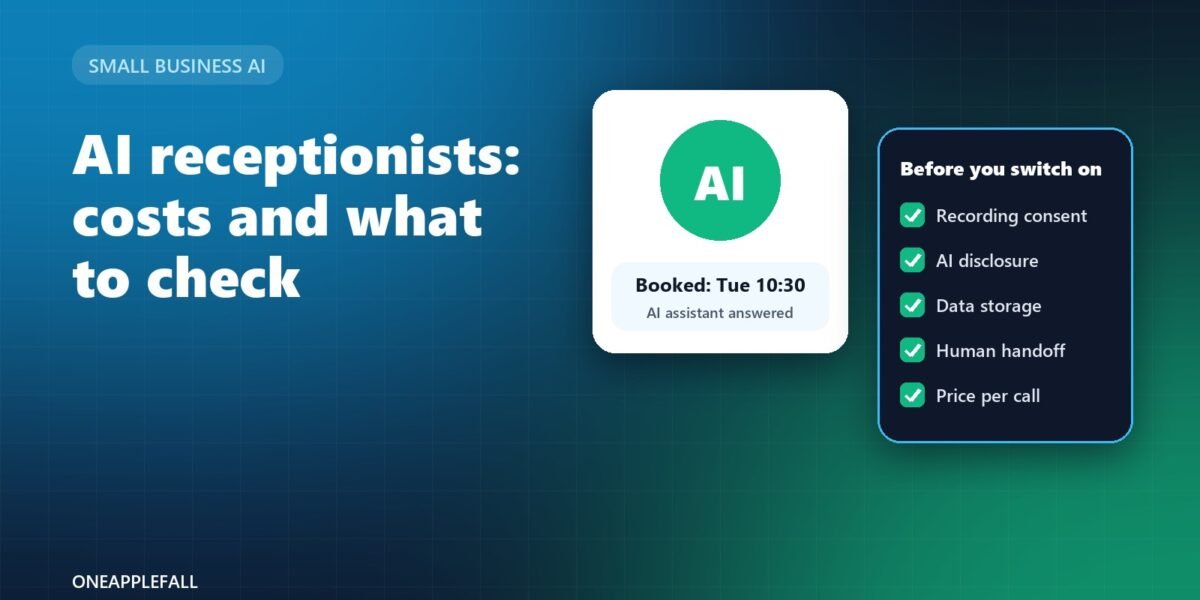
Illustration by OneAppleFall. Not a screenshot of any product.
Researched October 23, 2026
Missed calls are lost customers for a plumber, a dental office or a salon. AI receptionists, phone systems that answer with a natural-sounding AI voice, promise to pick up every call, answer common questions, book appointments and pass urgent callers to a person, around the clock. They are one of the categories most often featured in 2026 guides to AI tools for small businesses. [5]
This guide explains how they work, how vendors charge, and what US small businesses should check before switching one on, including call-recording consent laws.
Quick answer: AI receptionists answer your business line, handle routine questions and bookings, and hand off to a human when needed. Prices vary by pricing model: for example, Goodcall charges by unique caller (from $79 a month for 100 callers), while Smith.ai’s AI receptionist charges per call (a free plan with 25 calls, then from $150 a month for 75 calls). [1][2] Before you start, check call-recording consent rules (about a dozen states require everyone on a call to agree to recording) and how the service handles your callers’ data. [3]
This is a researched explainer based on vendor pricing pages, legal guides and published reporting. We have not tested these services, we don’t rank them, and nothing here is legal advice.
What an AI receptionist does
Most AI receptionist services offer some combination of:
- Answering calls 24/7 with a configurable greeting and voice. [2]
- Answering common questions (hours, prices, services, directions) from information you provide.
- Booking appointments directly into a calendar such as Calendly. [2]
- Taking messages and sending summaries by text or email.
- Transferring calls to you or a live person when a caller needs a human. Smith.ai, for example, says complex calls can be transferred to a live receptionist based in North America. [2]
- Connecting to your tools, such as a CRM, through integrations or automation platforms like Zapier. [2]
They work best for businesses that get many repetitive calls: home services, clinics, salons, law offices and restaurants.
How much an AI receptionist costs
Vendors use different billing units, so compare them on your own call volume. Two examples from official pricing pages, October 2026:
| Goodcall | Smith.ai AI Receptionist | |
|---|---|---|
| Billing unit | Unique callers per month (each phone number counts once) [1] | Calls answered [2] |
| Entry plan | Starter: $79/month for 100 unique callers [1] | Free: 25 calls a month [2] |
| Next plan | Growth: $129/month for 500 callers; Scale: $299 for 2,000 [1] | Pro: from $150/month for 75 calls [2] |
| Overage | 79¢ to 15¢ per extra caller, depending on plan [1] | $3.00 down to about $2.10 per extra call, depending on plan [2] |
| Trial | Free demo agent; you pay when you connect a number [1] | The free plan doubles as a trial [2] |
| Contract | Monthly [1] | Month-to-month, 30 days’ notice to cancel [2] |
What that means in practice: a business that gets 300 calls a month from about 150 different people would fall in Goodcall’s Growth plan ($129) under per-caller billing, but would need a higher Smith.ai tier under per-call billing. A business with few repeat callers sees less difference. Run your own numbers from your phone bill before choosing.
Other cost items to ask about: a new phone number or call forwarding, setup or onboarding fees, CRM integrations on lower plans, and the price of transfers to human staff.
The legal checks: recording, consent and AI voices
Call-recording consent
Many AI receptionists record or transcribe calls. US federal law sets a one-party consent minimum, but states can be stricter. [3] According to the Reporters Committee for Freedom of the Press:
- About 11 states primarily require all parties’ consent to record: California, Delaware, Florida, Illinois, Maryland, Massachusetts, Michigan (at least for recordings by uninvolved third parties), Montana, New Hampshire, Pennsylvania and Washington. [3]
- Connecticut and Nevada require all parties’ consent for phone calls (but not in-person conversations). [3]
- For calls between states, the cautious approach is to assume the stricter state’s law applies. [3]
The practical fix most businesses use is a short announcement at the start of the call, such as “This call may be recorded and is answered by an AI assistant.” Ask your vendor whether it plays one, and check the rules for your state with a lawyer.
Outbound calls with AI voices
If you plan to use the same system to call customers (reminders, follow-ups, promotions), US rules are stricter. In February 2024 the FCC confirmed that AI-generated voices count as “artificial or prerecorded voices” under the Telephone Consumer Protection Act. [4] That means you generally need the called person’s prior express consent (unless an emergency purpose or exemption applies), the call must identify who is responsible for it, and you must offer certain opt-out rights. [4] Inbound answering is lower risk, but check before turning on any outbound features.
Data and privacy
Ask every vendor:
- Where are call recordings and transcripts stored, and for how long?
- Are your calls used to train the vendor’s AI models, and can you opt out?
- Who at the vendor can listen to calls?
- Does it meet any rules specific to your field, such as HIPAA for healthcare providers?
Setting one up: a practical checklist
- Measure your calls first. How many a month, how many from repeat callers, and when they arrive (after hours?).
- List the top 10 questions callers ask and write clear answers; the AI is only as good as this information.
- Decide what must go to a human: emergencies, complaints, high-value sales.
- Connect your calendar and test bookings end to end.
- Add a recording and AI disclosure to the greeting.
- Start with after-hours calls only for a week or two, then expand.
- Listen to a sample of calls each week and update the answers.
- Tell regular customers that a new assistant answers the phone.
Is an AI receptionist worth it?
It is most useful if you regularly miss calls, get many repetitive questions, or book appointments by phone. It is a weaker fit if most of your calls are complex, emotional or high-stakes, where callers expect a person. Many businesses use a hybrid: AI for routine calls and after hours, people for everything else.
If you’re weighing AI for other customer conversations too, see our guides to the best chatbot platforms for small businesses and AI agents vs chatbots.
Questions
How much does an AI receptionist cost?
Entry plans in our examples range from free (Smith.ai, 25 calls a month) to $79 a month (Goodcall, 100 unique callers), with higher plans from about $129 to $299 or more. [1][2]
Do I have to tell callers they’re talking to AI?
Rules vary by state and are changing. Telling callers up front that an AI assistant is answering, and that the call may be recorded, is the safest practice and also helps with recording-consent laws. [3]
Can an AI receptionist book appointments?
Yes, many connect to calendar tools; Smith.ai, for example, lists AI scheduling with Calendly and other tools. [2]
Will an AI receptionist replace my front-desk staff?
For most small businesses it handles routine calls and after-hours coverage, while people handle complex or sensitive calls. Services like Smith.ai offer transfer to a live receptionist. [2]
Can it make outbound calls to customers?
Some can, but AI-voice calls fall under the Telephone Consumer Protection Act, which generally requires the person’s prior express consent. [4]