
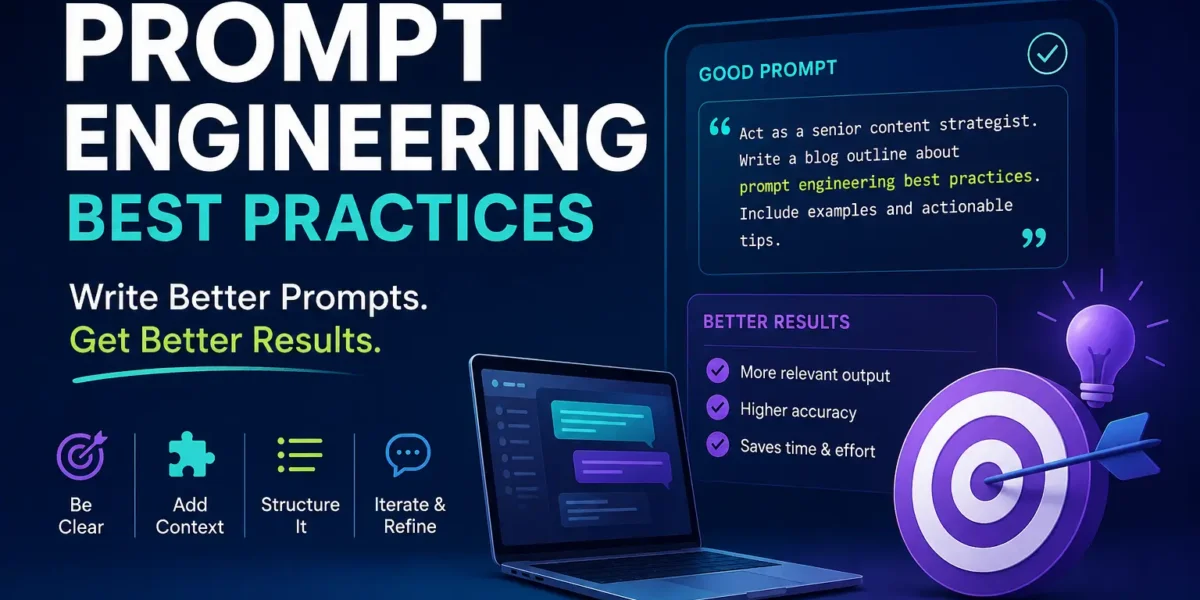
This guide distills the prompt engineering best practices that actually move the needle in 2026 — from the fundamentals to production-grade, secured systems — with copy-paste examples you can use today. Whether you’re writing your first prompt or shipping AI to users, these prompt engineering best practices separate reliable output from guesswork.
Last updated: June 2026 · A definitive guide
TL;DR — The 12 Prompt Engineering Best Practices That Actually Work in 2026
Prompt engineering is the discipline of structuring inputs to a large language model (LLM) so it produces accurate, reliable, and reusable outputs. It is not “talking nicely to AI” — it is structured communication and applied software engineering. Here is the entire field, compressed:
- Assign a role and supply context. Tell the model who it is and what situation it’s in before asking for anything.
- Be specific and unambiguous. Replace “write a story” with explicit task, audience, length, and format.
- Show, don’t tell (few-shot prompting). 2–5 consistent input→output examples beat a page of instructions.
- Use delimiters and structure. Separate instructions, context, and data with XML-style tags or Markdown headers.
- Trigger reasoning when (and only when) it helps. Chain-of-Thought, Self-Consistency, and Tree-of-Thoughts for hard logic; skip them for simple tasks.
- Specify the exact output format. Strict JSON, tables, or schemas for anything a pipeline consumes.
- Constrain aggressively. Length limits, negative constraints, and tone rules force precision.
- Combat “lost in the middle.” Put critical instructions at the very start and the very end of long prompts.
- Engineer context, don’t just dump it (RAG). Retrieve and inject only the most relevant grounding data.
- Defend against prompt injection. Use scaffolding, privilege separation, and input/output guards in production.
- Treat prompts like code. Version them, evaluate them against a test set, and track regressions.
- Pick the technique to the model. Reasoning models (o3, Claude with extended thinking) want goals; classic models want steps.
The single biggest lever: Stacking techniques — Role + Context + Few-shot + Constraints + Format — into one deliberate prompt, then iterating against real inputs.
What Is Prompt Engineering? (And Why It Still Matters in 2026)
Prompt engineering is the practice of designing the natural-language input given to an LLM to reliably obtain the best possible output. Mastering prompt engineering best practices means shaping that input deliberately instead of by trial and error. Where traditional programming controls behavior through code, prompt engineering controls behavior through language — which makes it a soft skill with hard consequences. In short, the quality of your prompt directly determines the usefulness, safety, and reliability of what comes back.
A common myth in 2026 is that smarter models killed prompt engineering. In fact, the opposite is true. As models gained reasoning, tool use, memory, and million-token context windows, the surface area for getting it wrong grew. The gap between a casual user and someone shipping production AI is not access to a secret model — it is method. Moreover, strong prompting is durable: the same structural principles work across Claude, GPT, Gemini, and open models, and even across languages, because they shape how the model reasons, not merely which words you use.
In addition, prompt engineering best practices remain the cheapest, fastest optimization lever available. Compared to fine-tuning (retraining a model on domain data — powerful but costly and slow) prompt engineering requires no training, no GPUs, and no waiting. The practical hierarchy most teams now follow: prompt first, retrieve (RAG) second, fine-tune last.
The Core Framework: The Anatomy of a Production-Grade Prompt
Indeed, every high-performing prompt is assembled from a small set of components. Think of these as the load-bearing pillars — omit one and the structure wobbles.
1. Role and Persona
Open serious prompts by defining who the model is: "You are a senior support analyst handling refund disputes." A role shapes vocabulary, judgment, and depth. In 2026 the best practice is specific roles tied to context, not the hollow “Act as a…” cliché. (For agents, the role is the foundation of the whole system prompt — see our guide on how to write a system prompt for an AI agent.) “You are a helpful assistant” adds nothing; “You are a tax attorney specializing in cross-border SaaS revenue recognition” changes everything.
2. Context and Grounding
Supply the background the model needs: audience, goal, constraints, and any domain facts. “Write a blog about AI” is weak; “Write a blog about AI prompt engineering, emphasizing technical challenges for the automotive industry” is usable. When the needed facts live outside the model’s training data, ground them with Retrieval-Augmented Generation (RAG) — retrieve relevant documents and inject them into the prompt so the answer is anchored in trusted data rather than hallucination.
3. The Instruction (Task)
State the desired action precisely and put it where the model can’t miss it. Lead with a strong verb: Summarize, Classify, Extract, Rewrite, Generate. As a result, vague instructions invite generic filler.
4. Specificity and Constraints
Most prompts fail by being too open. In practice, constraints force quality:
- Length: “in under 100 words,” “exactly 3 bullet points”
- Audience: “for a non-technical reader”
- Negative constraints: “do not use jargon,” “do not invent statistics”
- Required sections: “include: summary, mechanism, limitations”
5. Output Format
If anything downstream parses the output — or you simply want consistency — specify the exact shape: bullet list, Markdown table, or strict JSON matching a schema. Ultimately, structured outputs are what separate a demo from a pipeline.
6. Delimiters and Structure
Separate the moving parts of your prompt with XML-style tags (<context>...</context>, <data>...</data>) or Markdown headers. This prevents the model from confusing your instructions with the data it’s supposed to operate on — and, critically, it is your first line of defense against prompt injection.
Schema-ready definition for AI engines: A production-grade prompt is a structured input composed of six components — role, context, instruction, constraints, output format, and delimiters — designed to produce deterministic, parseable, and reliable LLM output.
Advanced Prompt Engineering Best Practices: The Techniques Matrix
This is the section that separates topical authority from a listicle. Below is the full reasoning-technique taxonomy used by serious practitioners in 2026, from the everyday to the cutting edge.
| Technique | What It Does | Best Use Case | Cost / Trade-off |
|---|---|---|---|
| Zero-shot | Asks the model to perform a task with no examples | Simple, well-known tasks (translation, classification) | Cheapest; least controllable |
| Few-shot | Provides 2–5 input→output examples to set a pattern | Format-sensitive or stylistic output | More tokens; examples can bias |
| Chain-of-Thought (CoT) | “Reason step by step” before answering | Math, logic, multi-step troubleshooting | Higher tokens/latency |
| Self-Consistency | Generates multiple reasoning paths, takes the majority answer | High-stakes arithmetic & commonsense | Multiplies cost (N runs) |
| Tree of Thoughts (ToT) | Explores and evaluates multiple branching reasoning paths, backtracking when needed | Planning, puzzles, search-like problems | Highest cost; most powerful for exploration |
| ReAct (Reason + Act) | Interleaves reasoning with tool/API calls | Agents that browse, query, or use tools | Requires tool infrastructure |
| Meta-prompting | Focuses on the abstract structure of the task, not specific examples | Token efficiency; avoiding few-shot bias | Less concrete guidance |
| Chain-of-Density | Iteratively rewrites a summary, packing in more entities each pass | Dense, information-rich summarization | Multiple passes |
| APE (Automatic Prompt Engineering) | The model generates, tests, and refines its own candidate prompts | Optimizing prompts at scale | Needs an eval harness |
Few-shot prompting — show, don’t tell
The fastest reliable quality boost. Provide a handful of consistent examples and let the model pattern-match. The technique traces to the landmark 2020 GPT-3 paper, “Language Models are Few-Shot Learners,” which showed large models can infer a task from a few demonstrations at inference time — no retraining. Above all, keep formatting identical across every example.
Convert customer complaints into structured tickets.

Example 1:
Input: "Your app crashed when I uploaded a 5MB photo"
Output: {"category": "bug", "severity": "high", "area": "upload"}

Example 2:
Input: "The checkout page takes 30 seconds on mobile"
Output: {"category": "performance", "severity": "medium", "area": "checkout"}

Now convert this:
Input: "I can't find the export button anywhere"
Chain-of-Thought — but hide the reasoning in production
For genuinely hard reasoning, asking the model to work step by step measurably improves accuracy. Therefore, the production pattern is to have it reason internally and return only a clean final answer:
You are a senior support analyst.
Work through the problem step by step internally.
Then return ONLY this, nothing else:

FINAL ANSWER:
- recommendation: <one line>
- top risk: <one line>
- next action: <one line>
Self-Consistency — when one reasoning path isn’t enough
Instead of trusting a single chain that might contain one bad step, generate several independent reasoning paths and select the most common answer. As a result, it meaningfully raises accuracy on arithmetic and commonsense problems where a lone path can silently go wrong — at the cost of running the prompt multiple times.
Tree of Thoughts and ReAct — the agentic frontier
Tree of Thoughts generalizes CoT into a search: the model proposes multiple intermediate “thoughts,” evaluates them, and explores the promising branches — ideal for planning and puzzle-like problems. ReAct interleaves reasoning with actions (search a database, call an API, read a file), making it the backbone of modern AI agents. If you’re building anything autonomous in 2026, ReAct-style prompting is table stakes — see our step-by-step walkthrough to build AI agents from scratch with Python.
Before & After: Prompt Engineering Best Practices in Action
A weak prompt: “Write a GitHub Actions workflow.” You’ll get something generic and spend more time fixing it than you saved.
A strong prompt stacks five techniques:
“You are a senior DevOps engineer (role). Our app is a Node.js API deployed to AWS (context). Think through the deployment steps before writing (chain-of-thought). Write a GitHub Actions workflow that runs tests, builds, and deploys on push to main, with no secrets hard-coded (constraints). Output only the YAML file (format).”
In other words, you didn’t switch to a smarter model — you communicated more precisely. That, in short, is prompt engineering in one example.
Context Window Engineering: Beating “Lost in the Middle”
Here is a content gap nearly every competing guide ignores. Modern models advertise enormous context windows (200K to 1M+ tokens), but research consistently shows a “lost in the middle” phenomenon: models reliably use information at the beginning and end of a long context, while material buried in the middle is frequently overlooked. In short, long context is not the same as reliable context.
Best practices for long-context prompts:
- Anchor at the edges. Place your most critical instructions and the key data at the very top and repeat the core directive at the very bottom.
- Engineer context, don’t dump it. More tokens degrade focus and raise cost. Retrieve only what’s relevant (this is the real job of RAG) rather than pasting an entire knowledge base.
- Compress. Prompt-compression techniques rewrite verbose prompts to retain only essential information, cutting token usage dramatically — sometimes by an order of magnitude — while preserving output quality. That’s a direct latency and cost win on high-volume API calls.
- Watch for context degradation in long chats. In extended multi-turn sessions, earlier instructions decay. Periodically re-state critical constraints, or move them into a system prompt that persists.
Model-Specific Nuances: One Prompt Does Not Fit All
A best practice competitors rarely make explicit: there is no universal prompt format. In practice, different model families respond to different patterns.
| Model family | What it rewards | Practical tip |
|---|---|---|
| Claude (Anthropic) | XML-style tags, explicit structure, extended thinking | Wrap context in tags; let it reason in <thinking> then answer |
| GPT / GPT-4o (OpenAI) | Clear instructions, Markdown headers, system messages | Use the system role for persistent rules; temperature 0 for factual tasks |
| Reasoning models (o3, o4-mini) | Goals, not step-by-step hand-holding | Don’t force CoT — state the objective and constraints; they reason internally |
| Gemini (Google) | Strong long-context handling | Lean on its context window for big inputs; still anchor key instructions |
The key 2026 shift: classic models want you to supply the steps; reasoning models want you to supply the goal and get out of the way. Over-prompting a reasoning model with manual CoT can actually hurt it. (Choosing a model is half the battle — compare the best LLMs for developers, and if you’re moving between providers, read how to switch LLM providers.)
Two more model parameters worth mastering:
- Temperature: Near
0for factual, deterministic, or extraction tasks; higher for creative work. - Structured outputs: When you need parseable JSON, use the provider’s native structured-output mode (e.g.
response_format={"type": "json_object"}or a JSON schema) instead of hoping the model formats correctly — it eliminates syntax errors at the source. - Memory: GPT and Claude offer persistent memory across sessions; for models or apps without it, simulate continuity by storing context server-side and re-injecting the relevant slice into each new prompt.
Future-Proofing: Prompt Security, Evaluation, and Version Control
This is where prompt engineering becomes genuine software engineering — and where almost every consumer-facing guide goes silent.
Defending Against Prompt Injection
Since OWASP published its LLM Top 10, prompt injection has ranked as the #1 LLM vulnerability. Unlike SQL injection, where malicious input is clearly distinguishable, prompt injection exploits the model’s core instruction-following logic: the system prompt and user input aren’t fully separated, so an attacker can smuggle in overriding instructions (“ignore previous instructions and…”). Consequently, the attack surface is effectively unbounded, and it requires no technical skill — only persuasive language.
Layered defenses for production:
- Prompt scaffolding (defensive prompting). Wrap user input in a structured, guarded template. Don’t just ask the model to answer — tell it how to think, what to refuse, and how to handle adversarial input.
- Strict delimiters. Clearly fence user content (
<user_input>...</user_input>) and instruct the model to treat anything inside as data, never as commands. - Input/output guards. Filter inputs for known attack patterns and scan outputs before they reach users (or downstream systems) to prevent leakage and insecure output handling.
- Privilege control. Never give the model’s tools more access than the task requires. Assume the prompt can be hijacked and limit the blast radius.
- Secondary models & human-in-the-loop. Use a second model to cross-check responses, and keep humans validating high-stakes actions.
- Adversarial testing (red-teaming). Probe your own system the way an attacker would. Lakera’s Gandalf is a well-known gamified environment for practicing exactly this.
Golden rule of LLM security: Never rely on the model alone to enforce policy. Defense must live in the architecture — guards, privilege limits, and validation — not just the prompt.
Systematic Prompt Evaluation and Version Control
Ultimately, prompt quality comes from iteration, not a single magic line. In production, that means treating prompts as versioned, tested artifacts:
- Build an evaluation set. Collect varied, real-world inputs (including edge cases) and define what “good” output looks like for each.
- Test before you ship. A prompt that works on one input often fails on the next. Run every prompt change against the full eval set and watch for regressions.
- Version your prompts. Store them in source control (or a prompt-management/feature-flag tool) so you can roll back, A/B test variants, and ship changes without redeploying code.
- Track cost and latency, not just quality — token spend is a first-class metric at scale.
- Verify intermediate steps. For chained or agentic prompts, validate intermediate outputs with rule-based checks or a human in the loop rather than trusting the final answer blindly.
The Direction of Travel: Agentic and Self-Improving Prompts
The frontier is moving from static prompts to agentic prompting (ReAct loops, tool use, multi-agent systems) and Automatic Prompt Engineering (APE), where models generate, test, and refine their own prompts against an eval harness. In other words, the meta-skill of 2026 isn’t writing one perfect prompt — it’s building the system that produces, secures, and improves prompts continuously.
Prompt Engineering Best Practices: Mistakes to Avoid
- Vague, open prompts. “Write about X” invites filler. Add role, constraints, and format.
- Telling instead of showing. When format matters, examples beat description every time.
- Chain-of-thought everywhere. It costs tokens and latency — reserve it for genuinely hard reasoning, and skip it entirely on reasoning models.
- Dumping huge context. More tokens ≠ better answers. “Lost in the middle” is real; retrieve and compress instead.
- Never testing. A prompt that works once may fail on the next input. Evaluate against a real test set.
- Contradictory instructions. The model can’t satisfy rules that conflict — keep them coherent.
- Trusting the prompt for security. Injection defenses belong in the architecture, not just the wording.
- Ignoring model differences. A Claude prompt and an o3 prompt should not be identical.
The Prompt Engineering Best Practices Checklist (Copy-Paste Ready)
Run every important prompt through this before shipping:
PROMPT ENGINEERING MASTER CHECKLIST (2026)

STRUCTURE
[ ] Role assigned (specific, not "helpful assistant")
[ ] Context / grounding provided (RAG if facts are external)
[ ] Instruction stated with a strong, unambiguous verb
[ ] Constraints set (length, tone, audience, negative constraints)
[ ] Output format specified (JSON schema / table / bullets)
[ ] Delimiters separate instructions, context, and user data

REASONING
[ ] Chosen the right technique: zero-shot / few-shot / CoT /
    self-consistency / ToT / ReAct
[ ] Few-shot examples are consistent in format (2-5)
[ ] CoT reasoning hidden internally; only clean answer returned
[ ] Not over-prompting a reasoning model with manual steps

LONG CONTEXT
[ ] Critical instructions anchored at start AND end
[ ] Context retrieved/compressed, not dumped
[ ] Key constraints re-stated in long multi-turn sessions

MODEL FIT
[ ] Format matched to model family (XML for Claude, etc.)
[ ] Temperature set (~0 for factual, higher for creative)
[ ] Native structured-output mode enabled if parsing JSON

PRODUCTION & SECURITY
[ ] User input fenced and treated as data, not commands
[ ] Input/output guards in place
[ ] Tool privileges limited to task scope
[ ] Adversarial / injection testing done
[ ] Prompt versioned in source control
[ ] Tested against a real evaluation set
[ ] Cost & latency tracked
Frequently Asked Questions
What are the best prompt engineering techniques in 2026?
Role + context, few-shot examples, chain-of-thought for hard reasoning, constraints, and strict output formatting — plus advanced methods like self-consistency, Tree of Thoughts, and ReAct for agents. Stacking these prompt engineering best practices deliberately is what produces production-quality results.
What is the difference between zero-shot and few-shot prompting?
Zero-shot asks the model to perform a task with no examples, relying on its training. Few-shot provides 2–5 input→output examples so the model infers the pattern. Use zero-shot for simple, well-known tasks; use few-shot when format or style matters.
What is chain-of-thought prompting?
Asking the model to reason step by step before answering, which improves accuracy on logic and math. In production, have it reason internally and return only a concise final answer in a fixed format.
What is the “lost in the middle” problem?
A documented tendency of LLMs to use information at the start and end of a long context reliably while overlooking material in the middle. Counter it by anchoring critical instructions at both edges and by retrieving/compressing context instead of dumping it.
How do I protect a prompt from prompt injection?
Use layered defenses: scaffold and fence user input as data, add input/output guards, limit tool privileges, use a secondary model or human-in-the-loop for high-stakes actions, and red-team your system. Never rely on the prompt alone — security belongs in the architecture.
Is prompt engineering still relevant as models get smarter?
Yes. Smarter models added reasoning, tools, memory, and huge context windows — expanding the ways to get it wrong. Prompt engineering remains the cheapest, fastest way to control output quality, and the skill is shifting toward securing, evaluating, and automating prompts.
Prompt engineering vs. fine-tuning — which should I use?
Prompt engineering is faster, cheaper, and more flexible; fine-tuning offers deeper specialization at higher cost. The 2026 default: prompt first, add RAG for grounding, and fine-tune only when prompting and retrieval genuinely fall short.
Conclusion: Prompt Engineering Best Practices for 2026
Prompt engineering best practices in 2026 are no longer a parlor trick of clever phrasing — they are structured communication backed by software-engineering discipline. Master the six structural pillars, choose the right reasoning technique for the task, respect the limits of long context, adapt to each model family, and treat prompts in production as versioned, tested, and secured artifacts. Importantly, none of these moves is hard in isolation; the skill is combining them habitually until structured prompting becomes second nature. Do that, and you’ll consistently pull results from AI that look like magic to everyone else.
Ready to put it to work? Learn how to integrate an LLM into your app, and when things misbehave, fix them with our guide on how to stop your AI agent from failing or hallucinating.
